
Personality in Action: Assessing Big Five Traits as Styles of Perception and Behaviour
About the Workshop
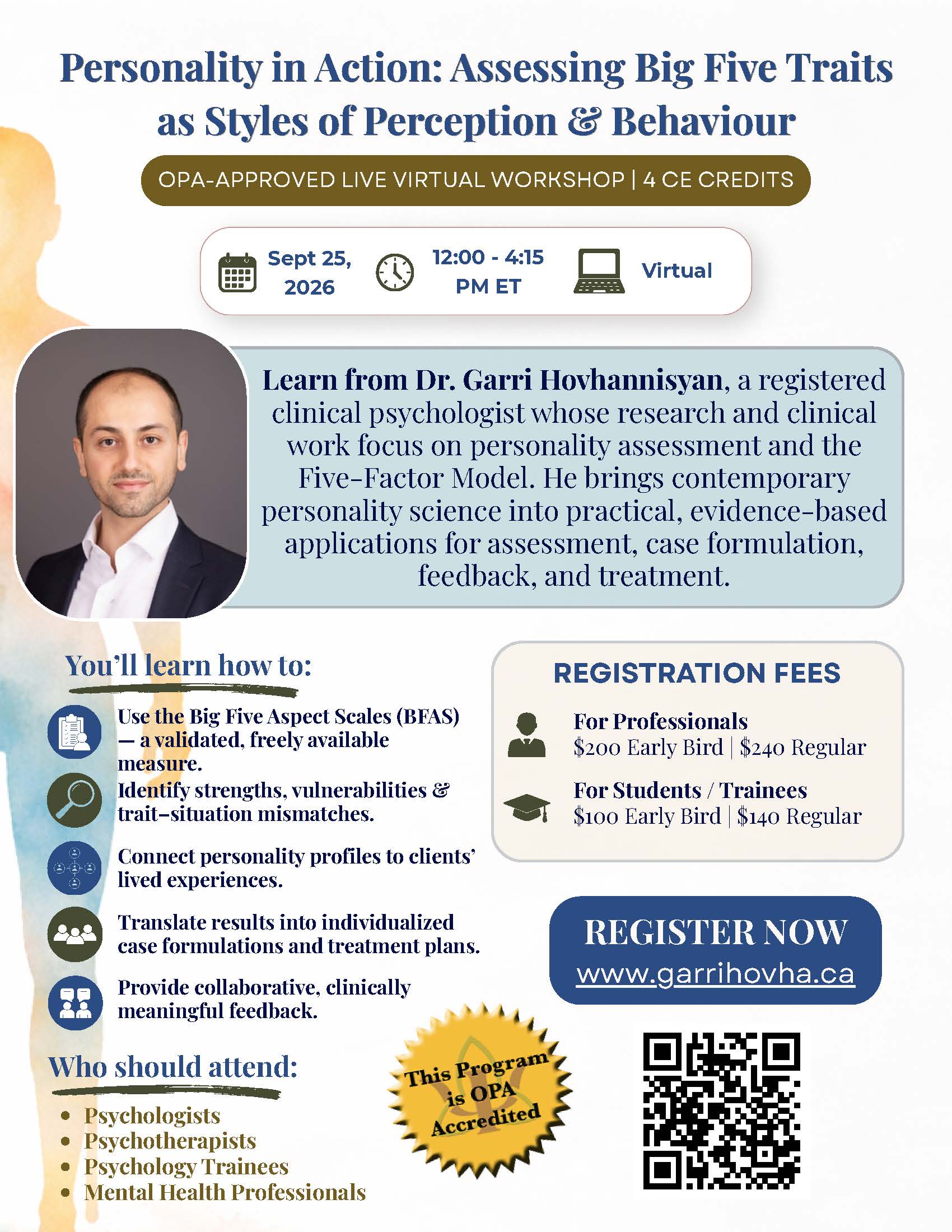
This workshop demonstrates how to tap into the Big Five personality model’s clinical potential, turning it from a static measurement tool into a dynamic intervention. By understanding traits as styles of perception and action that concretely shape a client’s unique “grip” on the world, clinicians will learn to step inside the client’s lived experience to see what matters to them from the standpoint of their personality. Moving beyond descriptive labels, this workshop provides a methodical approach to identifying how specific trait configurations drive a client’s repetitive negative cycles, and more importantly, how to put a clinical dent in those cycles. Participants will learn how to:
•Operationalize Theory: Translate cutting-edge Big Five frameworks into practical, clinically useful tools for understanding client concerns in therapy and assessment.
•Utilize Accessible Assessment: Implement the Big Five Aspect Scales (BFAS)—a highly validated and freely available assessment that takes clients only minutes to complete, bypassing the cost and time barriers of traditional testing.
•Transform Feedback: Turn assessment feedback from a plain reading of test scores into a deeply validating, collaborative therapeutic intervention.
•Apply Targeted Formulation: Use de-identified case examples to identify trait-situation mismatches, uncover hidden strengths, and translate personality profiles into highly individualized treatment plans.
What You Will Learn
By the end of this workshop, participants will be able to:
1.Describe the hierarchical structure of Big Five personality traits, including domains and aspects, and explain how the BFAS operationalizes this structure.
2.Explain how Big Five traits can be understood as styles of perception, motivation, action, and adaptive functioning in lived experience.
3.Interpret and contextualize Big Five trait profiles within clients’ lived experiences.
4.Identify clinically relevant Big Five profile patterns that may inform assessment feedback, treatment planning, and case conceptualization.
5.Apply a structured approach to collaborative Big Five feedback using the BFAS, including discussion of strengths, vulnerabilities, trait-situation mismatches, and implications for psychotherapy.
6.Describe the limits of Big Five and BFAS-based interpretation, including appropriate and inappropriate applications across client presentations, concerns, and diagnostic contexts.
Accredited by the Ontario Psychological Association for 4 hours of continuing education.